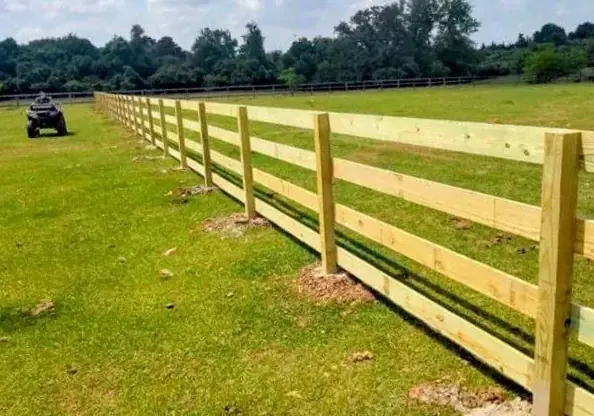
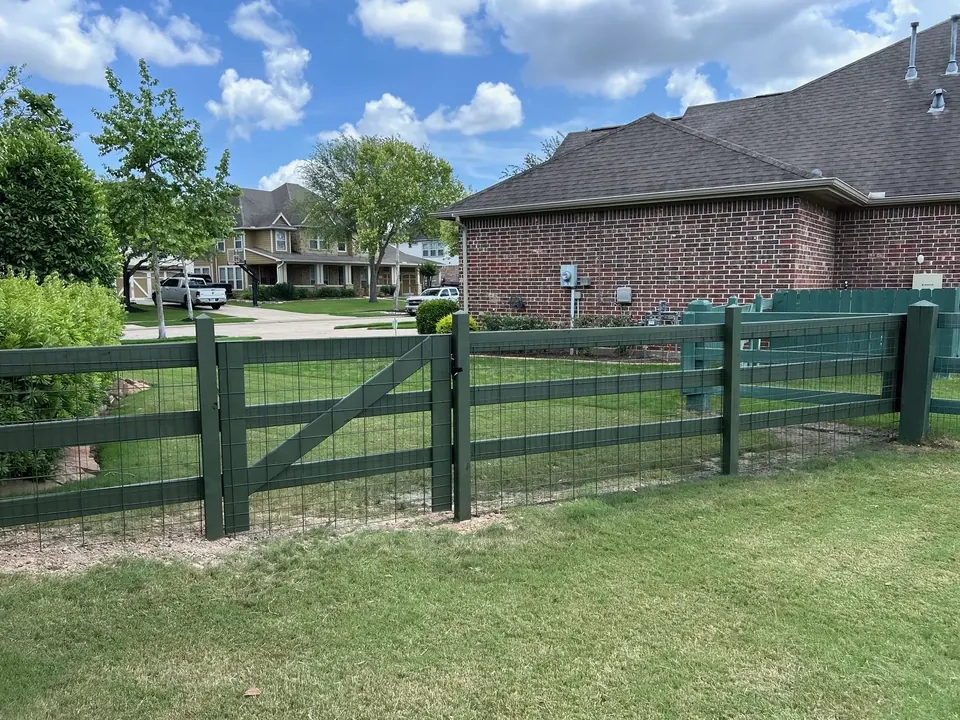
A three-rail pasture fence and a rail fence with wire mesh, both in Fulshear.
Farm and ranch fence comes down to two questions: what has to stay in (or out), and how much of the line people will see. Wire is the workhorse for long pasture lines. Rail and pipe go where animals push hard or where the fence faces the road. The hardware that holds it all together, the corners, braces and gate posts, matters more than any of it.
Materials we build with
| Material | Best for | Good to know |
|---|---|---|
| No-climb wire | Horses, and mixed livestock | Woven wire with small openings a hoof can't go through. Usually topped with a rail or board for visibility. |
| Woven field wire | Goats, sheep and dogs on acreage | Larger openings than no-climb at a lower cost. Choose spacing by your smallest animal. |
| Welded wire mesh on rail | Dogs and small animals behind a rail fence | Keeps the open rail look while closing the gaps. Mesh goes on the inside of the rails. |
| Wood rail and split rail | Frontage, drives, front pasture, paddocks | Two to four rails. Looks good from the road; needs a stain or sealer to last. |
| Welded pipe | Pens, arenas, alleys, frontage | Steel pipe posts and rails; the longest-lasting option. Painted pipe needs touch-ups. |
| Chain link | Dog runs, equipment yards, budget perimeters | Lowest cost per foot for a secure line; black blends into pasture. |
| Ranch and pasture gates | Trailer, tractor and walk access | Tube or pipe gates hung on posts sized for the weight. |
By animal
- Horses: no-climb wire with a top rail or board, rail with mesh, or pipe. Keep the line highly visible and free of anything a horse can catch a hoof or halter on. See horse fence.
- Cattle: pipe for pens and working areas; woven wire or pipe on the perimeter, with strong corners. Cattle lean on fences, so bracing matters.
- Goats and sheep: woven field wire or no-climb, tight to the ground with no gaps at the bottom. Goats test every fence.
- Dogs on acreage: welded wire behind rail, no-climb, or chain link for a run. Close the gap at the bottom and use self-closing gates near the house.
- Chickens and small animals: a smaller-mesh pen inside the larger fence usually works better than fencing the whole property tight.
- Ask the experts too: we build fences, not herds. Your vet or the county extension office can tell you what your animals need.
Posts, braces and wire that last here
- Corner and end braces (H-braces) hold the tension of a long run. Without them, the wire sags by the first dry summer.
- Wood posts or steel. Treated wood posts are common for woven wire and rail. Steel pipe posts last longest at gates, corners and pipe runs.
- Heavier zinc coating on wire. In Gulf Coast humidity, wire with a heavier galvanized coating, often sold as Class 3, rusts more slowly than the light coat on cheaper rolls. Ask what coating you're getting.
- Gate posts sized for the gate. A 12 to 16 ft pasture gate is a lever on its post. Set it deep and brace it, or it sags.
- Clay and drought. Brazos bottom clay swells and shrinks. Posts set for it and braced ends keep the line straight through the seasons.
Wire or wood: the trade-offs
| Wire (no-climb, field wire) | Rail and pipe | |
|---|---|---|
| Cost per foot | Lowest on long lines | Several times wire |
| Look from the road | Nearly disappears | Finished, ranch look |
| Visibility to animals | Low; add a top rail or board | High |
| Upkeep | Re-tension now and then; splice after storms | Seal wood; paint pipe touch-ups |
| Storm repair | Splice and re-tension | Replace a rail or section |
The common plan: rail or pipe along the road, the drive and around the house; wire across the back pasture. It looks right from the road and keeps the total reasonable.
Gates for farm and ranch
- Pasture gates in tube or pipe, commonly 10 to 16 ft, sized to the widest equipment that passes through.
- Walk gates near barns and the house, so you aren't swinging a big gate for every trip.
- Gate placement: put gates where animals and equipment naturally move, away from low spots that turn to mud, and with room to swing.
- Entry gates at the road, set back far enough for a truck and trailer to pull off the pavement. See ranch entry gates.
Cost
Wood rail runs $24 to $33 per foot installed (September 2026); chain link runs $15 to $45. Wire and pipe are priced after we walk the line, because corners, braces, gates, terrain, clearing and access move the number so much. See acreage fencing for cost per acre, and financing through Hearth.
Questions we hear
What is the safest fence for horses?
No-climb woven wire with a top rail or board, rail with mesh, or pipe fence. The goal is small openings and a line horses can see.
What fence keeps goats in?
Woven field wire or no-climb, tight to the ground with no bottom gaps, on posts with braced corners. Goats test every weak spot.
Why do corners and braces matter so much?
On a long wire or rail run the corners and ends carry nearly all the load. If they move, the whole line goes slack. Braced corners keep it tight for years.
How often should I check a ranch fence?
After every big storm and at least once or twice a year. Look for limbs on the wire, loose clips or staples, moved posts and dropped rails.
Can you add wire to my existing rail fence?
Often, yes, if the posts and rails are sound. We check during the estimate.